
Why Do I Overreact, and How Can I Stop Being Overreactive?

Most people assume strong reactions mean something is wrong with them. But what if your responses are actually your nervous system trying to protect you? When you understand why your body reacts before your brain can reason, everything starts to make more sense — and the shame begins to fade. You don’t need perfection or willpower. You just need clarity, compassion, and a few gentle tools to help your system feel safe again. So if you’ve ever thought, Why am I reacting like this? And how can I stop being so reactive?” then you, my friend, are already asking the right question!
In This Post
Why strong emotional reactions happen
What’s really going on in inside you
Why your reactions are not character flaws
Small, practical ways to start calming your system
When (and why) support can make a difference

When Small Things Feel Big (And You Wonder Why)
You know those phone calls — like when you simply need to update your mailing address with your credit card company. First, you wait on hold for 73 minutes - Yes, 73 minutes that you can neither make nor receive calls, 73 minutes that you can’t go run your errands, 73 minutes of your life on hold. Are you feeling that tension just reading this?!? Then finally, on minute 74 a real, live human finally answers only to ask you 10 security questions just to confirm that you are indeed you. After that, they need one questions — confirm your last purchase; what was your last payment date & amount, what’s your mother’s maiden name; you know the routine. And then they do the unthinkable - they tell you they now have to transfer you to another department that will be able to handle your request.
And when they finally do… the call disconnects.
Is your blood boiling just reading this? (I can feel my temperature rising 😤)
Of course it is! Anyone would feel irritated after spending so much time on something that should have taken one minute.
There is nothing wrong with you for reacting. Your reaction is human — and it makes sense.
If you’re like many high-functioning, caring, busy humans, you might wonder whether you “get triggered too easily.” One moment irritation flares, frustration takes over, or tears hit without warning… and shortly after, you’re left feeling deflated, ashamed, or confused.
Pause here with me for a second:
There is nothing wrong with you! Nothing. Wrong. With. You!
What if this pattern wasn’t a sign of failure, but an invitation — a message from your nervous system that it’s working overtime to protect you?
FAQ
Q1: Is overreacting a mental health diagnosis?
A1: No. It’s simply describes of a pattern of reacting; it is not a diagnosis or character flaw.
Q2: Why do I feel ashamed after strong reactions?
A2: Because many of us were taught to self-criticize instead of self-understand. Shame is learned — not natural.
Q3: Does overreacting mean I’m “too sensitive”?
A3: No, it does not. Over sensitivity is not the problem — your reaction is just information telling you that something doesn’t feel ok.
Why Your Body Reacts So Strongly (Hint: It’s About Protection, Not Drama)
Your nervous system’s job is to protect you, not judge you. And it’s fast — much faster than your thinking brain.
Think of your nervous system like a built-in alarm system:
It scans for danger, threat, rejection, conflict, embarrassment, overwhelm, or loss — long before you can reason through it.
This is why reactions can feel sudden or “too big”:
Your body is responding before your mind catches up.
Sometimes, that system becomes over-trained or over-alert, especially if you’ve spent years in situations where you had to stay on guard, like:
unpredictable relationships
criticism or emotional uncertainty
high responsibility with little support
traumatic experiences
environments where mistakes were met with harsh responses
Like camping in bear country where every twig snapping feels like impending doom.
And when vigilance becomes familiar, almost anything can feel like a bear outside the tent - even if it’s just a chipmunk…
Not because you’re weak, dramatic, or irrational — but because your body (aka your nervous system) has learned to stay ready. You had to stay ready to stay safe.

FAQ
Q1: Why do I react sometimes even if nothing “bad” is happening?
A1: Your nervous system is responding to what feels similar to past stress, not only what is physically present.
Q2: Why do small triggers affect me more when I’m tired or overwhelmed?
A2: Lower capacity = less regulation fuel. Stress (hangry is a form of stress) & fatigue dramatically shrink your emotional window of tolerance, or your ability to stay calm, cool & collected.
Q3: Why do small triggers affect me more when I’m tired or overwhelmed?
A3: Yes — chronic stress, burnout, loss, fear, and emotional unpredictability can shape the nervous system too.
Your Brain on Connection vs. Your Brain on Protection
Our nervous systems generally move between two broad states:
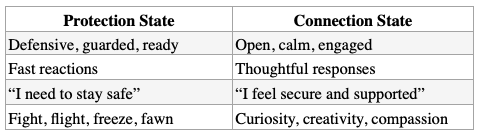
When you “overreact,” it’s usually not a personality issue — it’s your protection state taking over. This is our survival mode kicking in to keep us safe. The trouble is, we can’t be in both connection and protection at the same time; it’s one or the other.
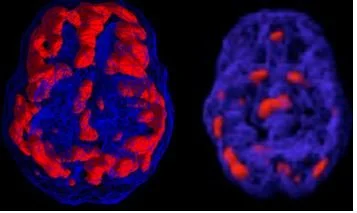
The image on the left is a brain stressed out in protective mode, the brain on the right is a brain in connection mode.
Your protective reactions are not random — they are patterns your body believes will protect you. Even if you know logically that you are just fine, something in your nervous system was coded in to say that when you see, hear, smell or sense xyz, it means danger, and you’ve got to do whatever you can to protect yourself. Thank heavens we have this survival instinct! It really does protect us when we see a car skidding on ice towards us, or when someone is screaming at us, or when we smell fire while we’re in the house.
The trouble comes when we know in our heads that we are ok, and we will be ok, but our system reacts anyhow. I like to say that the longest highway in the world is the one from our head to our heart. Thankfully, there are things we can do to help our nervous system (which we often think of as our emotions that come from our heart) to recognize only true cues of danger as such, and to also recognize cues of safety as they are intended like someone smiling at you while they hold the door open for you.
FAQ
Q1: Does this mean I’ll always react like this?
A1: No — nervous systems are changeable. With support and practice, they can learn new responses.
Q2: Is protection state bad?
A2: Not at all — it’s essential for survival. The goal isn’t to eliminate it, but to strengthen choice and flexibility.
Q3: Can connection state be learned later in life?
A3: Yes — through safe relationships, regulation practices, and gentle repetition.
Gentle Steps Toward Calming Reactions (Without Shaming Yourself)
You don’t need perfection, a personality transplant, or a 30-day challenge.
Change begins with awareness and small, doable signals of safety.
Try experimenting with one or two of these:
Name what’s happening without judgment
“My nervous system thinks something (name this something as best you can) might not be ok.” Drill a little deeper than surface level here. For example, your system might be responding with a rapid heartbeat and quick, shallow breathing when you get up to speak in front of a group at work. Sure, you could say that the speaking in front of everyone is what your system is responding to, and that wouldn’t be wrong, but really, at a deeper level, what your system is responding to might be a fear of making a mistake (which is really a fear of embarrassment, and if you have a deeper look at that, is the fear of embarrassment actually a fear of rejection? This level of specificity is golden!Slow the moment by one breath
Even 3–5 seconds helps your thinking brain come back online.Notice the story you make up about what’s happening
This will help you discover what’s hidden beneath the surface; a fear or a past hurt is most likely. And it gives you something to refute, or at least to put into perspective.Ask a connection-based question
“What part of me is trying to protect me right now?”Choose to decide later, not in the spike
Nothing feels safer than options, and when you decide later how you’re going to respond to something, you get to take control back instead of letting those automatic reactions take over.
And remember:
Sometimes emotional reactions are signals of needs that have gone too long without being met. What I am most looking for is whether things are getting better over time. There are thousands of websites with tips of what to do in the moment to deal with our reactions, but I always want people to understand that they can get to a place where the reactions either don’t happen, or they at least go from a 9 out of 10 on the Richter scale to a 2 out of 10. I hope that the latter is your choice. Not learning how to live with reactivity, but resolving the inner-workings that cause it in the first place.
FAQ
Q1: Should I try to “stay calm” no matter what?
A1: No. Authentic emotions are healthy. The goal isn’t to squash them — it’s to understand them.
Q2: What if my overreactions hurt my relationships?
A2: Repair is very powerful! I would actually say that rupture followed by repair is even more powerful than having no rupture at all. The rupture repair process really helps us build resilience because we can see that something hard can happen, but we can still be ok. The rupture is essential to our healthy emotional development. Honest conversations build safety and new patterns, both for you and for the one you overreacted with/in front of.
Q3: Can professional support help?
A3: Yes — especially if your reactions feel confusing, automatic, or tied to past experiences.
Final Thoughts
If you’ve been hard on yourself for reacting “too much,” please hear this:
You are not dramatic
You are not failing
You are not broken
You are a human with a nervous system that learned to protect you — likely for good reasons.
And now, you get to learn new ways to help it feel supported, resourced, and safe enough to respond rather than react.
Small shifts count.
They add up.
And you don’t have to figure it out alone.
I’d love to hear if you have experienced the beauty of a healthy rupture/repair cycle.
If so, how did it impact you?
If you’d like support understanding your reactions, building emotional safety, and creating new patterns of relating — I’d be honoured to walk alongside you. When you’re ready, reach out, ask a question, or book a consult. You don’t have to navigate this on your own.